You make decisions all day long, often in a rush, with one single question in mind: is my company being steered correctly? In SMEs (Small and Medium Enterprises) and VSEs (Very Small Enterprises), management rarely relies on a single model. It combines several approaches, the balance of which directly determines performance.
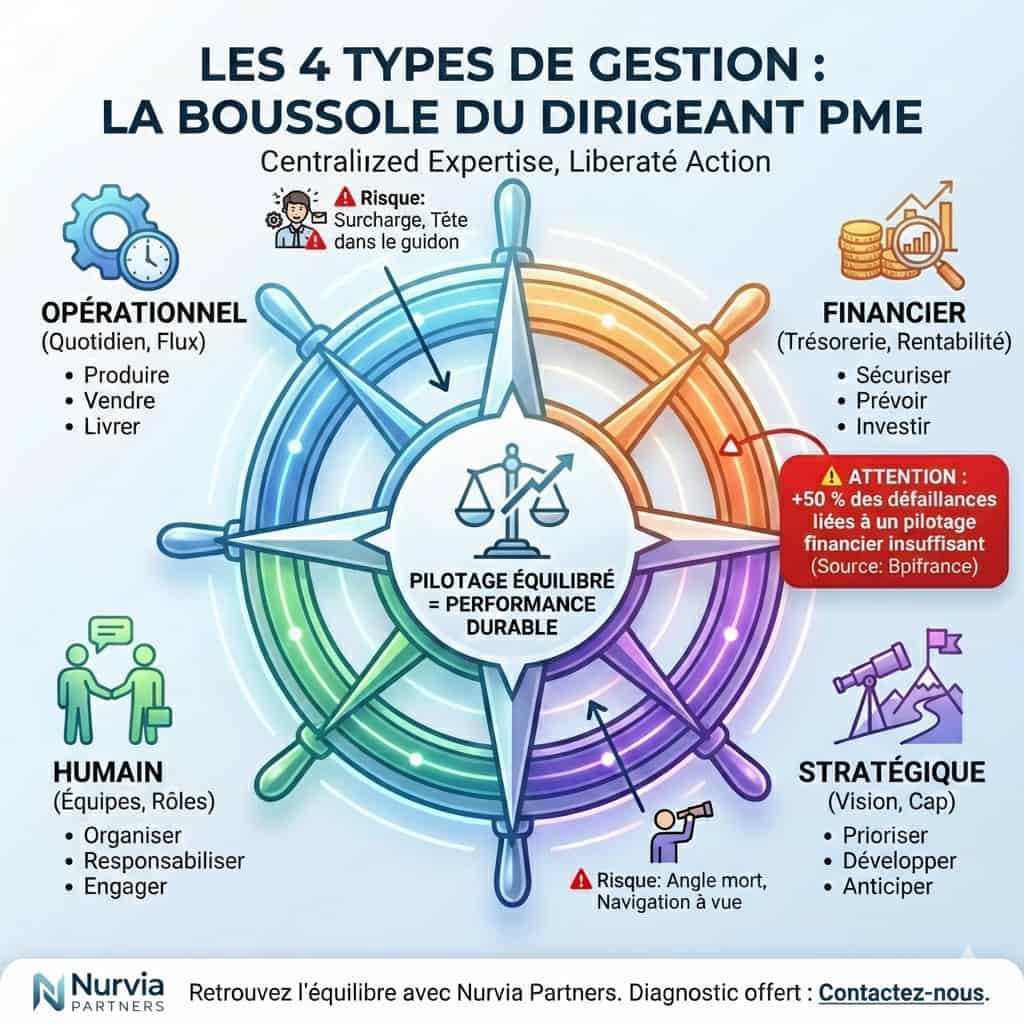
Generally, we distinguish four main types of management. Operational management concerns daily life: producing, selling, delivering, responding to customers. It is indispensable, but when it consumes all your time, it prevents you from taking a step back. Financial management aims to secure cash flow, margins, and investments. According to Bpifrance, more than 50% of SME failures are linked to financial steering issues, often due to a lack of visibility rather than a lack of activity.
Human management focuses on team organization, role distribution, and accountability. Take the example of a service SME where everything was escalated to the CEO. By rebalancing human and operational management, the company reduced interruptions by 30% and improved team engagement. Finally, strategic management consists of setting a clear course: priorities, development, and structural choices. An industrial VSE thus clarified its strategic priorities, which enabled it to increase its turnover by 12% without expanding its organizational structure.
The problem is not using one or the other of these management types but getting stuck on just one—often the operational. At Nurvia Partners, we help leaders rebalance their management style through a short, pragmatic, and result-oriented diagnostic. We identify key levers and implement, with you and your teams, simple adjustments to better steer the company.
Want to know if your management is balanced and high performing? Contact Nurvia Partners for a management diagnostic and regain control over your time, your decisions, and your performance.